


God’s Word for You
Genesis 6:11-13 All flesh
by Pastor Timothy Smith on Tuesday, October 27, 2026
11 But the rest of the world was morally corrupt in God’s sight and was full of violence. 12 God saw how corrupt the earth had become, for all the people on earth had corrupted their ways. 13 So God said to Noah, “I am going to put an end to all people, for the earth is filled with violence because of them. I am now going to destroy them along with the earth.
I illustrate the flood account this way when I teach this in the classroom. The six parts are, Corruption (Genesis 6:1-12), Command (Genesis 6:13-7:4), Compliance (Genesis 7:5-10), Catastrophe (Genesis 7:11-24), Completion (Genesis 8:1-14), and Covenant (Genesis 8:15-22).
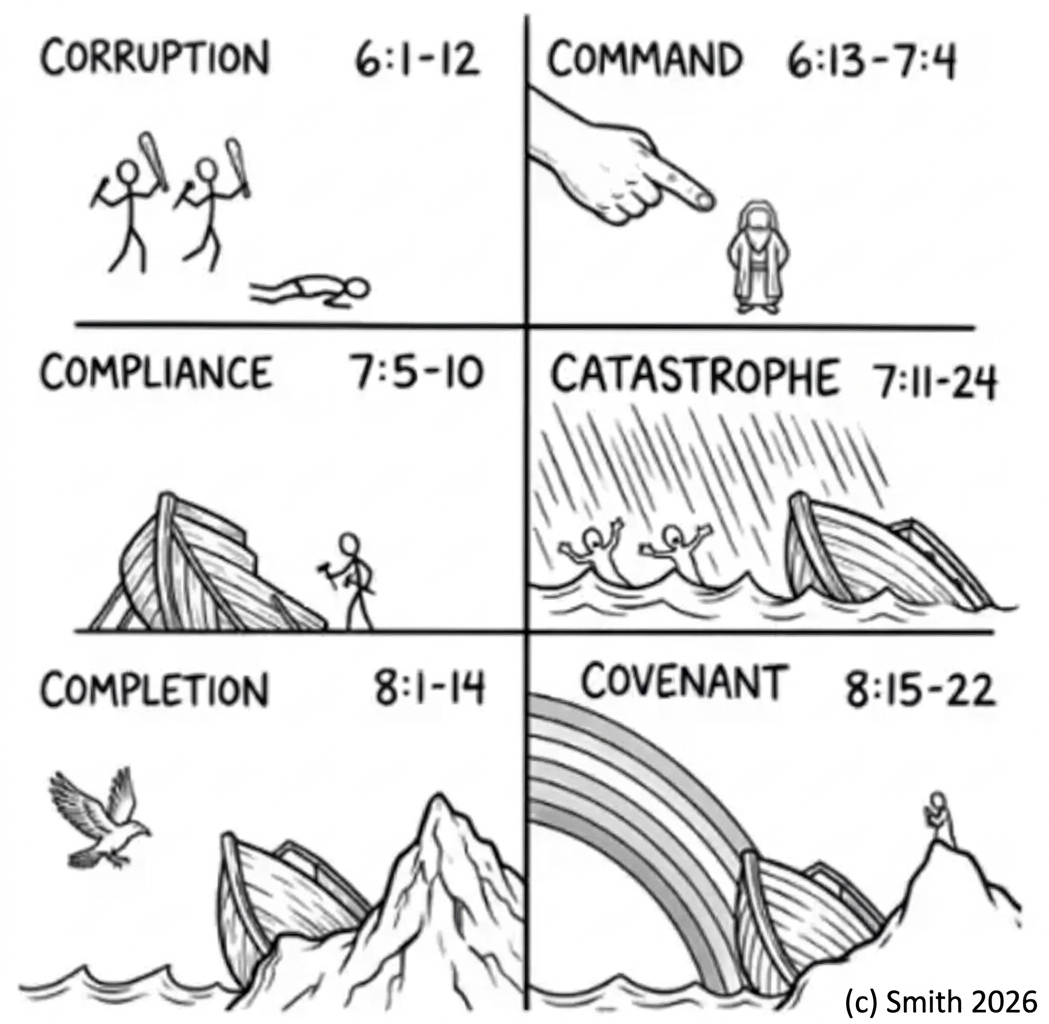
The verse begins with the conjunction “but,” showing the difference between Noah and his family and “the rest of the world.” The inhabitants of the world, perhaps numbering the millions by this time, were all and entirely corrupt. In verse 9, Noah was described as “righteous,” and he uses a term we could hyphenate as “righteous-devout.” This was God’s grace at work in the heart of this man, and it would be worth noting that this is the first time that Moses uses the word “righteous.” It is this devout righteousness that is contrasted with the moral corruption and violence of that generation.
In verse 12 Moses reports that “all the people on earth” had corrupted themselves. In Hebrew, this is “all flesh,” but Moses does not mean that the animals and birds were becoming corrupt such as by cross-breeding, or by descending into eating carrion or each other’s eggs, or other behaviors that might disgust or shock some people. The animals do not possess souls, and they are not under the law. Animals do not sin, cannot be baptized for their benefit, and are not held accountable under the law, as we see in Exodus 21:35, where a bull that kills another is to be sold but not killed, unless it was in the habit of goring other beasts, and therefore it is held accountable for killing, but not under the same judgment as “an eye for an eye, and a tooth for a tooth” (Leviticus 24:14).
So this judgment was about mankind, and God’s holy verdict was that the damage was too severe; man was beyond repair. Professor Jeske writes: “God no longer saw the beautiful, orderly world he had once set in motion, but a disorderly world, a lawless underworld of gangsters, a jungle where violating the rights of others was the order of the day.”
So the end is now proclaimed. God says: “I am going to destroy them along with the earth.” He begins this phrase with one of the words often translated as “behold.” This is to show just how unexpected this judgment will seem to everyone. The coming destruction is God’s doing, not man’s. During the second year of the Civil War, writer Henry Adams worried: “Someday science may have the existence of mankind in its power, and the human race commit suicide by blowing up the world” (1862). But while we should be careful with the mighty powers available to us, the end of the world will not be man’s choice nor man’s mistake. God is the Creator, and God will indeed bring this world to an end. As one of our professors put it, “”The world did not—and will not—self-destruct.”
The unique judgment of the Flood is that God unmade what he had made, but preserved one small portion in order to begin again. God was making his will known to Noah, to prepare him for the disaster ahead and for the work he was going to have to undertake. His preaching would continue. The early Church Father Clement of Rome echoes Hebrews 11:7, saying, “Noah preached repentance, and those who obeyed were saved” (1 Clement 7:6). But who were “those who obeyed”? Only Noah and his sons and their wives. But the Lord also had in mind the animals, as we will see. Clement later said, “And faithful Noah by his service preached regeneration. Through him the Master saved the living creatures that entered the ark together” (1 Clement 9:4).
As his understanding of God’s unfolding plan deepened, Noah’s faith in God also deepened. Noah realized just how vast this judgment was to be. It was no local judgment, no forest fire or earthquake that was going to upset things on this mountain or in that valley. This was to be a universal, global catastrophe. Everything on earth was about to change by being destroyed.
But the end of the world in Noah’s time is absolutely a warning about the coming end of the world. We pray that God will keep us ready through his word and sacraments. Like Noah, we must put our trust in the grace of God. We give him praise and glory because he made us. We want to use his name only for preaching, teaching, and proclaiming him. We pray that his kingdom will come and that he will use us for useful work in his kingdom. We ask him for our daily needs. We plead for him to forgive our sins, and we respond by forgiving each other. We plead for him to lead us away from temptations and to rescue us from sin and every evil. This, which is the Lord’s Prayer, expresses the foundation and the footing of our faith. We pray also with David, “I trust in your word” (Psalm 119:42), “I believe in your commands” (Psalm 119:66),
For whatever troubles come to us, we should turn to God for our help, just as Noah did. We are helpless when confronted with our sins. “If a person sins and does what is forbidden in any of the LORD’s commands, even though he does not know it, he is guilty and will be held responsible” (Leviticus 5:17). How can we do anything about this? We can’t, but Jesus did. Therefore we put our trust in him, look to him for forgiveness and help, and rely on him to guide us as we live day by day on the path he has given us.
In Christ,
Pastor Timothy Smith

Pastor Smith serves St. Paul’s Lutheran Church in New Ulm, Minnesota. To receive God’s Word for You via e-mail, please visit the St. Paul’s Lutheran Church website.