


God’s Word for You
Daniel 4:28-32 The folly of the king
by Pastor Timothy Smith on Friday, October 10, 2025
28 All of this happened to King Nebuchadnezzar. 29 Twelve months after this, he was walking on the roof of his royal palace in Babylon. 30 The king was speaking, and he said, “Is this not Babylon the Great, which I have built by my mighty power as a royal residence and for the glory of my majesty?” 31 The words had just come from the king’s mouth when a voice came from heaven, “King Nebuchadnezzar, this is what is decreed for you: The kingdom has been taken from you. 32 You will be driven away from among people, and your dwelling shall be with the animals in the field. You will have to eat grass like an ox, and seven times will pass over you, until you know that the Most High rules the kingdoms of men and gives them to whomever he wants to.”
Nebuchadnezzar had made many changes to the city of Babylon. Assyriologist Eckhard Unger made excavations of the city and wrote a scholarly book about it in 1921. The map here is his work.
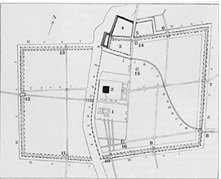
The Tigris River ran roughly north to south on the west side of the old city, and Nebuchadnezzar built up a new city on the west bank of the river (to the left on the map). Broad avenues and beautiful structures made the city truly wonderful, perhaps the largest city at that time in the entire world.
One of the features of this marvel was the “hanging garden,” although “overhanging” (κρεμαστός) would have been a more descriptive translation. The garden (or gardens) were not actually suspended, but were evidently planted high on the terrances of a ziggurat or step-pyramid, with many trees that towered in the air overhead. Nebuchadnezzar had it built for his wife Amytis, a Mede, who missed the lush greenery of her homeland. The garden was one of the Seven Wonders of the ancient world, but sadly was the first of the Seven to be destroyed (in the early part of the first century AD).
Fabulous, famous, enormous—the city was all of these things and more. But the king took credit for it all himself. He had forgotten that his mighty power and his glorious majesty were not really his to be proud of. Daniel’s careful wording tells us that while the king’s words still hung in the air (“just came from his mouth”) that a voice came, or more literally “fell,” from heaven. This was the voice of God himself, speaking to the king and proclaiming his judgment.
This king, who had made so many decrees, now had a decree proclaimed about him. His kingdom was taken away. He was guilty of taking personal credit for his achievements—which would never have been possible had the Lord God not placed him on the throne. Also, he claimed that the glory of this was all his. All things happen in the universe, above the earth, upon it, and beneath it, to the glory of God (Philippians 2:10). The heavens declare his glory (Psalm 19:1), his glory is over the earth and seas (Psalm 29:3), and his glory is even in things that are deeply concealed (Proverbs 25:2). His glory rises up above the angels of heaven (Ezekiel 9:3), and all glory belongs to him (Revelation 19:1).
God’s judgment fell on him as soon as God’s voice had spoken. Nebuchadnezzar lost his humanity, his identity, and his sanity. Professor Jeske correctly describes his madness as boanthropy, imagining oneself to be a cow or an ox, and the former king began to act like an animal at once. He hated his clothing, craved grass to eat, and wanted to get out of the confines of the palace. This is not all that happened; we will see even more in the verses that follow. But he was judged by God, and nothing would bring him out of this madness until God permitted it and restored his mind back to him.
“Seven times” is the duration that God proclaimed. If these “times” were years, as they appear to be later on in the book (Daniel 9:24-26), then we can guess (it is only a guess) that Nebuchadnezzar was struck down by God about eight years (perhaps even only seven) before the end of his reign. He died in 562, and his son Evil-Merodach was alone on the throne for the remainder of that year and all the next, until he was assassinated in August of 560 BC by his sister’s husband. So it’s possible that Nebuchadnezzar was struck down with this madness in 570 or 569 BC, recovering his wits at the end of that time, as we have said before.
This punishment was severe, but not so severe that this poor wretch of a man could not recover. He had been told, “Break away from your sins with righteousness.” He was not being damned to hell, he was being brought down to nothing in this lifetime to preserve his paltry, faulty, meager faith, like a broken reed or like the smoking wick of a candle. God was blessing him with his burden. By smashing his power and authority and pride, God was giving him a clear view of his faith, and of God’s place in his life.
We might pray for a such a disaster to come to a loved one in our life; someone who seems to have turned their back on God, but who once believed in him. Would that God would crush their pride, or their doubt, or whatever is the problem, and bring them back to trust and faith! Then the grace of the Lord Jesus Christ would be with their spirit, and their place in heaven would be restored, dusted off, and made ready for them at long last.
In Christ,
Pastor Timothy Smith

Pastor Smith serves St. Paul’s Lutheran Church in New Ulm, Minnesota. To receive God’s Word for You via e-mail, please visit the St. Paul’s Lutheran Church website.