


God’s Word for You
Daniel 3:19-20 The fiery furnace
by Pastor Timothy Smith on Friday, September 26, 2025
19 Then Nebuchadnezzar became even more furious with Shadrach, Meshach, and Abednego, and his attitude toward them was changed. He commanded that the furnace should be heated seven times hotter than usual. 20 Then he commanded some of the strongest men that were in his army to bind Shadrach, Meshach, and Abednego, and to throw them into the burning fiery furnace.
You can’t really hear it in English, but Daniel makes a play on words (paronomasia) when he says that Nebuchadnezzar’s “attitude” toward the men changed. This is more literally “the image of his face” that changed, which is the same word that Daniel has been using for the golden “image” or statue that the king set up. He is showing the changeableness of false gods and the people who construct them. The gods of the pagans are not greater than human beings, but less; much less. They are merely things, objects, like a plate or a cup or a doorstop. They are easily made, easily broken, with no power or mind of their own. They are no more than things, useful for a moment and then thrown away. Or put another way, “Nebuchadnezzar’s ‘image’ (face) can change, but the image (statue) he set up for others to worship cannot.” On the other hand, God our Father and our Lord Jesus Christ do not change. “Jesus Christ is the same yesterday and today and forever” (Hebrews 13:8).
Nebuchadnezzar commands a seemingly impossible thing, that the furnace be heated “seven times hotter than usual.” A modern kiln used to fire pottery or bricks approaches 1800 degrees. The hottest part of a candle’s flame might touch 2,000 degrees. “Seven times hotter” in this case surely means “hotter,” but must be a hyperbole. The surface of the sun is less than seven times hotter than the hottest part of a candle’s flame. In the apocryphal addition to this chapter, called “The Prayer of Azariah” or “The Song of the Three Children,” the author describes additional materials being added to the furnace: “naptha, pitch, tow, and brushwood” (Prayer of Azariah 1:23). Any product of natural oil or gas such as naphtha or even tar would produce a hotter flame that would burn longer, provided there was enough airflow.
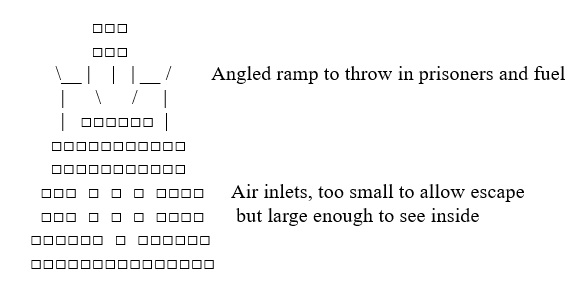
There is no elegance to this rendering, but it is meant to show that the furnace was probably a tall structure with something like a chimney above, an angled ramp high up, and air inlets which allowed viewing at about ground level and would allow plenty of air to make the fire hotter.
Perhaps to show off his military prowess, the king ordered the men to be seized and bound by the strongest of his soldiers, probably men from his own personal bodyguard. But Shadrach and his companions had a stronger guard. “O LORD, my strength, come quickly to help me” (Psalm 22:19). “O God, you are my fortress” (Psalm 59:9).
As God himself said: “Was my arm too short to ransom you? Do I lack the strength to rescue you? By a mere rebuke I dry up the sea, I turn rivers into a desert; the fish rot for lack of water and die of thirst. I clothe the sky with darkness and make sackcloth its covering” (Isaiah 50:2-3).
And again, “God is our refuge and strength, an ever-present help in trouble” (Psalm 46:1). His attributes of omnipotence and omnipresence are described there in a single line of poetry. Our God is infinite in power, infinite in wisdom, infinite in majesty, and infinite in his gracious love. He will look after us, and he is able to rescue us from any danger.
In 1972, a commercial jet was flying over East Germany when a bomb was set off on board the plane, tearing it to pieces and killing 27 of the 28 people on board. However, a stewardess named Vesna Vulović, fell without a parachute from about 6 miles up (33,000 feet) and survived. After being hospitalized for several months and after her broken bones healed, she walked with a limp for the rest of life, but she lived. Her experience and the depression that followed it (she had survivor’s guilt) steered her toward the Bible and to Christ, and she became a devout Christian. She was carried home to heaven in 2019.
Some of the things that happen to us place us into God’s hands for his protection. Our faith can be strengthened by these things, which is what was happening to Shadrach, Meshach, and Abednego. In other cases, such as for young Vesna, these things tear away at our unbelief or doubt, and leave us searching for the truth, which comes through the preaching of the gospel. In any case, we see God’s plan to save us at work in every part of our lives. What does not kill us does not always make us stronger. It may weaken us terribly. But it can be a paving stone on the path to bring us closer to our Jesus, and his love will strengthen us and bring us safely home to heaven.
In Christ,
Pastor Timothy Smith

Pastor Smith serves St. Paul’s Lutheran Church in New Ulm, Minnesota. To receive God’s Word for You via e-mail, please visit the St. Paul’s Lutheran Church website.